
Quick Answer: A grease trap is a small indoor unit installed under the sink that handles low-volume kitchens with a flow rate under 50 gallons per minute. A grease interceptor is a large underground tank outside the building, designed for high-volume operations exceeding 50 GPM. Both devices capture fats, oils, and grease (FOG) before they reach the sewer — but the right device for your restaurant depends on your kitchen’s size, output, and what your local municipality requires.

If you run a restaurant in Northwest Arkansas and you’ve ever asked “do I need a grease trap or a grease interceptor?” — you’re not alone. The terms are often used interchangeably, but they refer to two different devices with different sizes, locations, and maintenance schedules. Choosing the wrong one doesn’t just cause headaches — it can lead to FOG compliance violations, fines, and a very uncomfortable conversation with a health inspector.
This guide breaks down exactly how grease traps and interceptors differ, which type NWA restaurants are typically required to install, and what your maintenance schedule should look like for each. Whether you’re opening a new location in Fayetteville or trying to figure out why your current setup keeps backing up, here’s what you need to know.
Do Grease Traps and Interceptors Do the Same Thing?
Yes — but on very different scales. Both devices are designed to do one thing: intercept fats, oils, and grease (FOG) before they flow into the municipal sewer system. When FOG enters a sewer line, it cools and solidifies, building up over time into the kind of blockage that causes sewer backups, environmental violations, and expensive emergency repairs.
The mechanics are identical. Wastewater flows from your kitchen drains into the device. FOG floats to the top (because it’s lighter than water), food solids sink to the bottom, and cleaner water flows out the other side into the sewer. The difference between a trap and an interceptor is how much wastewater they can process — and how quickly.
Grease trap: Handles flow rates under 50 gallons per minute (GPM). Compact, installed indoors, usually directly under a sink. Best for smaller operations with limited kitchen activity.
Grease interceptor: Handles flow rates over 50 GPM. Large tank installed underground outside the building. Required for high-volume kitchens — full-service restaurants, schools, hospitals, and commercial food processing.
What Are the Key Differences Between a Grease Trap and a Grease Interceptor?
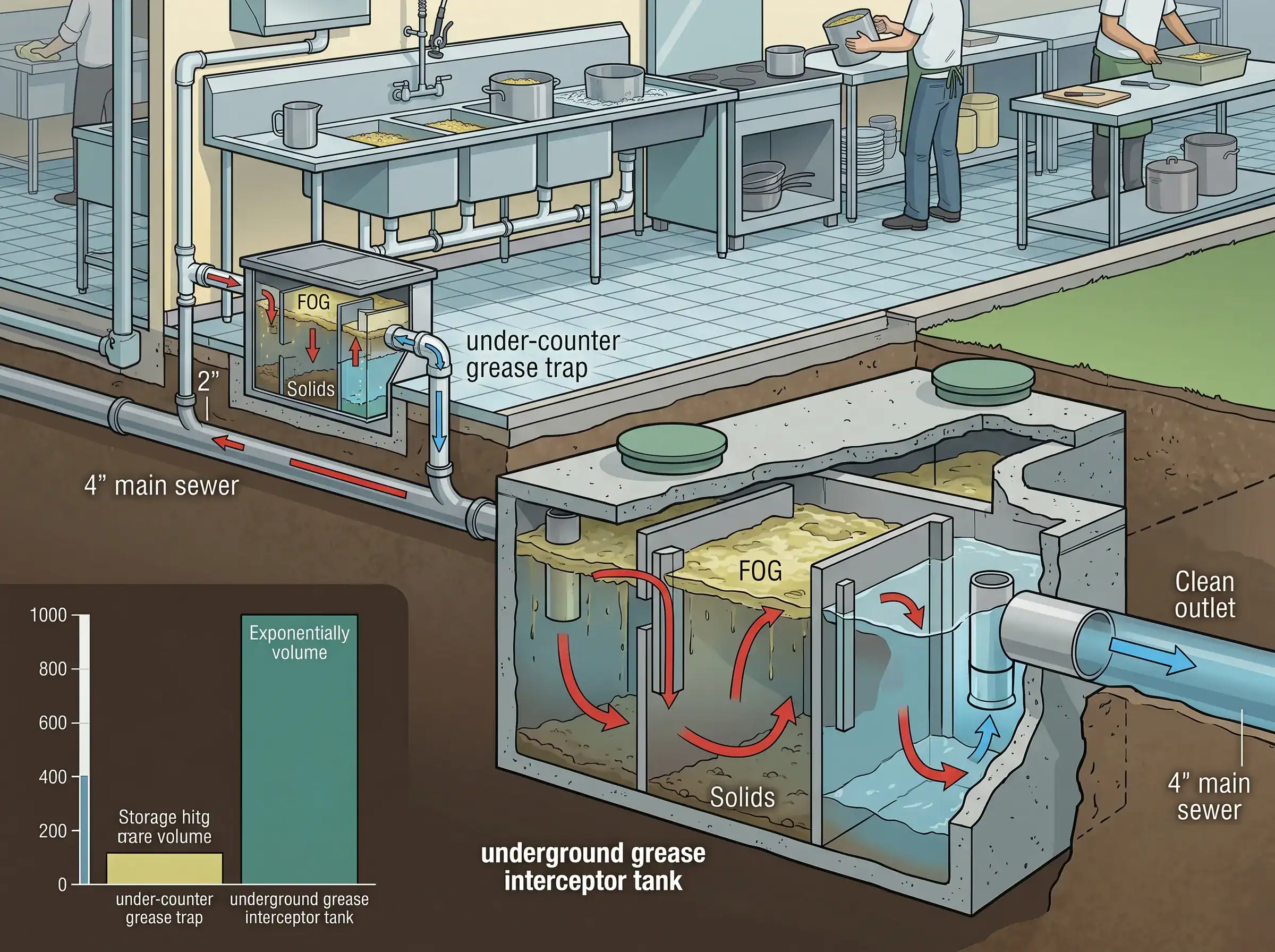
Here’s a side-by-side comparison of every factor that matters when deciding between the two:
| Feature | Grease Trap | Grease Interceptor |
|---|---|---|
| Flow Rate | Under 50 GPM | Over 50 GPM |
| Location | Indoors, under sink | Outdoors, underground |
| Size / Capacity | 10–500 gallons | 500–2,000+ gallons |
| Material | Steel or plastic | Fiberglass or concrete |
| Maintenance | Monthly or more often | Every 1–3 months |
| Best For | Small cafés, food trucks, low-volume kitchens | Busy restaurants, schools, hospitals, multi-station kitchens |
| Installation | Simple; fits under sink | Requires excavation + outdoor space |
✅ Pro Tip: The 50 GPM dividing line comes from the Uniform Plumbing Code, which most Arkansas municipalities follow. If your kitchen is near that threshold, always check with your local health department or plumbing authority — some cities mandate interceptors regardless of measured flow rate.
Which Device Does Your NWA Restaurant Actually Need?
The honest answer: it depends on your kitchen volume, the number of fixtures you’re running, and what your specific city requires. Here’s a practical decision guide by restaurant type:
| Restaurant Type | Typical Flow Rate | Device Needed | Service Frequency |
|---|---|---|---|
| Coffee shop / café (1–2 sinks) | 10–20 GPM | Grease trap | Monthly |
| Fast-casual (3–4 stations) | 25–45 GPM | Grease trap or interceptor — check local code | Monthly to every 6 weeks |
| Full-service restaurant (50+ seats) | 50–100 GPM | Grease interceptor | Every 30–90 days |
| High-volume kitchen / chain location | 100+ GPM | Large interceptor (1,000+ gal) | Monthly or as needed |
Restaurants across Fayetteville, Springdale, Rogers, and Bentonville generally fall under local FOG ordinances that require documented grease management programs. For any full-service restaurant — one running multiple sinks, a commercial dishwasher, and high meal volume — a grease interceptor is almost always required, not just recommended.
One thing that catches a lot of NWA restaurant operators off guard: even if your flow rate math suggests a grease trap would suffice, your municipality may have a minimum capacity requirement — sometimes 500 gallons or more — for all new food service installations. That means you could do the calculations correctly and still fail an inspection because the device doesn’t meet the local code floor.
✅ Pro Tip: Before buying or installing any grease management device, contact your local public works or environmental services department to confirm exactly what’s required for your kitchen classification. Getting this wrong is expensive to fix.
How Often Does Each Type Need to Be Pumped and Cleaned?

Maintenance frequency is one of the most practical differences between the two devices — and one of the most misunderstood. The rule of thumb: when a grease trap or interceptor reaches 25% capacity with FOG and solids, it needs to be serviced. A smaller device fills faster. A larger one has more runway.
Grease traps should typically be cleaned monthly, sometimes more often for busy operations. Their small holding capacity means grease builds up quickly. Some health departments require weekly cleaning logs for kitchens with high FOG output.
Grease interceptors require service every 30 to 90 days for most restaurants, though the exact interval depends on your kitchen’s volume. A high-volume location producing large amounts of FOG daily may need monthly pumping. A smaller operation with an oversized interceptor might stretch to quarterly service.
In both cases, every service visit should come with a signed waste manifest — a document that records the gallons removed, the destination facility, and the hauler’s license information. That manifest is your proof of compliance if a health inspector ever asks.
Where Should NWA Restaurants Invest vs. Where Can They Save?
💎 Worth Investing In
- Correct sizing from the start: An undersized grease trap or interceptor causes constant backups, odor problems, and compliance headaches. Paying for the right device upfront is far cheaper than emergency service calls or fines.
- A documented pumping schedule: Consistent, scheduled service with manifest documentation protects you during health inspections and demonstrates good-faith FOG compliance.
- A licensed local provider: Choosing a hauler who operates their own licensed processing facility — not just a truck that drives your waste to another state — means faster service, lower costs, and a shorter paper trail.
💰 Where You Can Save
- Skipping grease trap additives: Enzyme or bacterial additives marketed to restaurants often push FOG through the trap rather than capturing it — creating a compliance liability downstream. Most municipalities prohibit them.
- Consolidating service: If you have both a grease trap and used cooking oil collected separately, using a single provider for both reduces administrative overhead and scheduling complexity.
Grease Trap vs. Grease Interceptor at a Glance
- Grease traps = small, indoor, under-sink, best for low-volume kitchens under 50 GPM
- Grease interceptors = large, underground, outdoor, required for high-volume restaurants over 50 GPM
- Both work the same way — the difference is scale, location, and maintenance frequency
- Most full-service NWA restaurants are required by local FOG ordinance to install a grease interceptor
- Every service visit — for either device — should include a signed waste manifest for your compliance records
- Not sure which you need? Contact your local municipality or call Ozark Grease Pros at (479) 448-7755 for a free assessment
Frequently Asked Questions
Is a grease trap the same as a grease interceptor?
No — though the terms are often used interchangeably, they refer to distinct devices. The Uniform Plumbing Code defines the difference by flow rate: a grease trap handles under 50 gallons per minute, while a grease interceptor handles over 50 GPM. In practice, this means traps are small indoor units and interceptors are large underground tanks. When you hear a plumber or inspector use either term, it’s worth clarifying which specific device they mean for your kitchen classification.
Which does my NWA restaurant actually need — a trap or an interceptor?
For most full-service restaurants in Fayetteville, Springdale, Rogers, and Bentonville, local FOG ordinances require a grease interceptor. Smaller operations like coffee shops, food trucks, or single-sink cafes may qualify for an under-sink grease trap — but even then, your municipality may have a minimum capacity requirement. The safest approach is to contact your local public works or environmental services department before purchasing or installing any device. Ozark Grease Pros can also assess your trap and provide a compliance recommendation.
How often does each device need to be pumped or cleaned?
Grease traps need cleaning monthly or more frequently, because their small capacity fills quickly. Most health departments recommend cleaning when the device reaches 25% FOG capacity. Grease interceptors, due to their larger holding capacity, typically require service every 30 to 90 days — though high-volume kitchens may need monthly pumping. Both devices require signed waste manifests on every service visit as proof of FOG compliance.
Can the same company service both grease traps and grease interceptors?
Yes. A qualified grease management company services both types. The critical detail is making sure your provider is licensed to haul grease waste and documents every service with a waste manifest. Ozark Grease Pros services both grease traps and interceptors across Northwest Arkansas — and hauls all waste to our licensed processing facility in Siloam Springs, AR, where it’s processed on-site rather than trucked to Tulsa or Little Rock.
What happens during a health inspection if I have the wrong grease device?
If a health inspector determines your device is undersized or not the required type for your kitchen volume, you’ll likely receive a notice of violation requiring you to upgrade at your own expense — on a timeline set by the inspector. Repeat violations can escalate to fines or temporary closure. Restaurants that have been reclassified — say, from a grease trap to an interceptor requirement after adding equipment or increasing meal volume — often face this situation mid-operation. When in doubt, get ahead of it.
Related Guides
- What Is a Grease Trap and Why Restaurants Need One — ozarkgreasepros.com/blog/what-is-a-grease-trap/
- Grease Trap Pumping Cost Guide — ozarkgreasepros.com/grease-trap-pumping-cost-guide/
- Grease Trap Cleaning Services — ozarkgreasepros.com/services/grease-trap-cleaning/
- Grease Trap Pumping Services — ozarkgreasepros.com/services/grease-trap-pumping/
- Grease Recycling — ozarkgreasepros.com/services/grease-recycling/
- FOG Compliance Guide — ozarkgreasepros.com/environmental-compliance/
- Service Areas Across Northwest Arkansas — ozarkgreasepros.com/service-areas/
Not Sure Which Device Your NWA Restaurant Needs? We Can Help.
The difference between a grease trap and a grease interceptor isn’t just technical — it’s a compliance question. Getting it right the first time keeps your kitchen running, your health inspection clean, and your FOG documentation airtight. Getting it wrong means an upgrade on someone else’s timeline, often with a fine attached.
Ozark Grease Pros serves restaurants across Fayetteville, Springdale, Bentonville, Rogers, Siloam Springs, and the greater NWA region. We pump and clean both grease traps and interceptors, provide manifest documentation on every visit, and haul all waste to our licensed processing facility right here in Northwest Arkansas.
Call (479) 448-7755 or visit ozarkgreasepros.com to schedule service or get a free assessment. We’ll help you figure out exactly what your kitchen needs — and keep you on a schedule that makes compliance automatic.
About Ozark Grease Pros: Ozark Grease Pros is Northwest Arkansas’ licensed grease trap pumping, cleaning, and recycling specialist. Based in Siloam Springs, AR, we operate the only regional grease recycling processing facility in NWA — serving restaurants in Fayetteville, Springdale, Bentonville, Rogers, and beyond with FOG-compliant, manifest-documented service. Call (479) 448-7755 or visit ozarkgreasepros.com to schedule service.

